
Enigma Collection


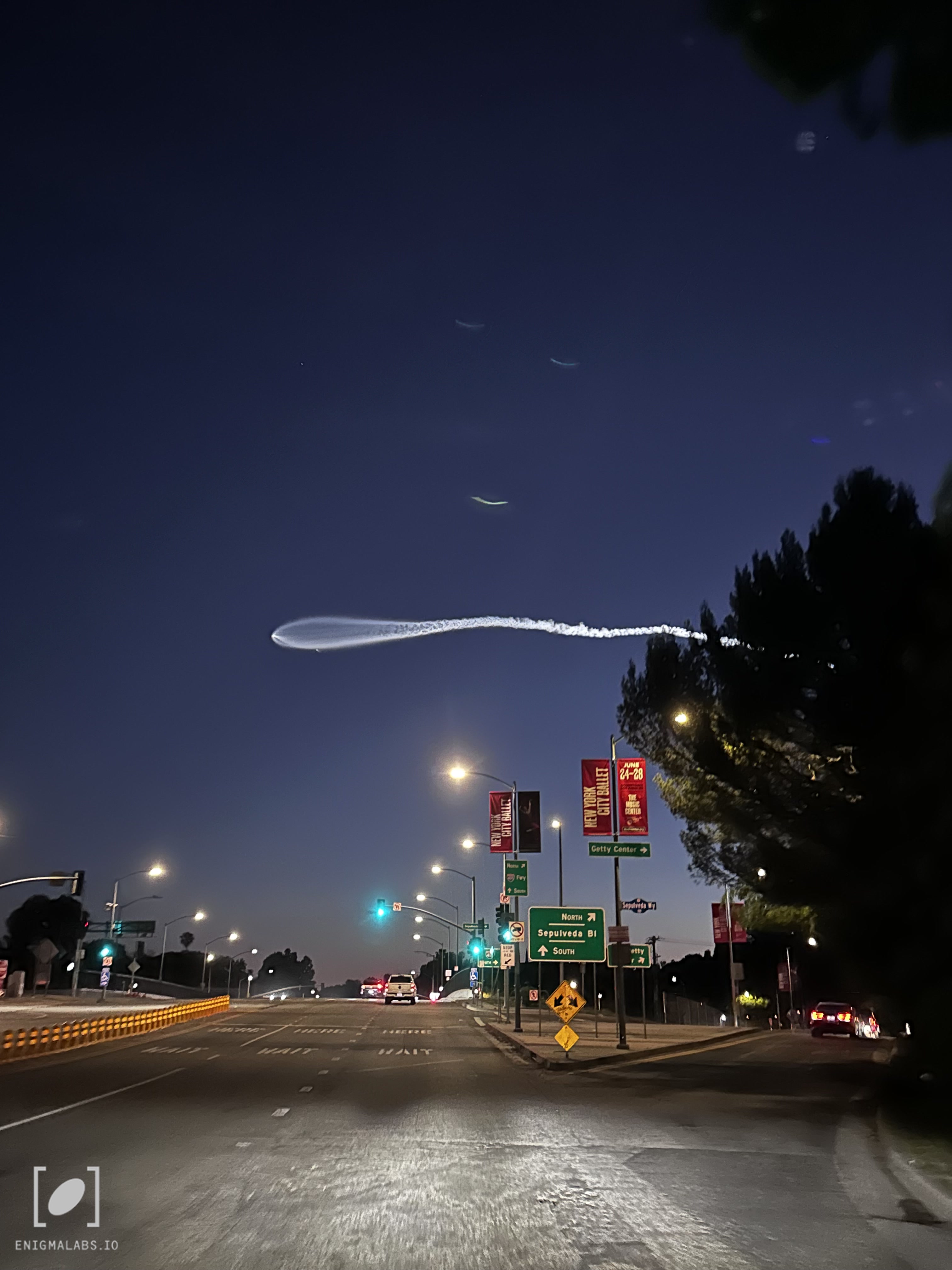
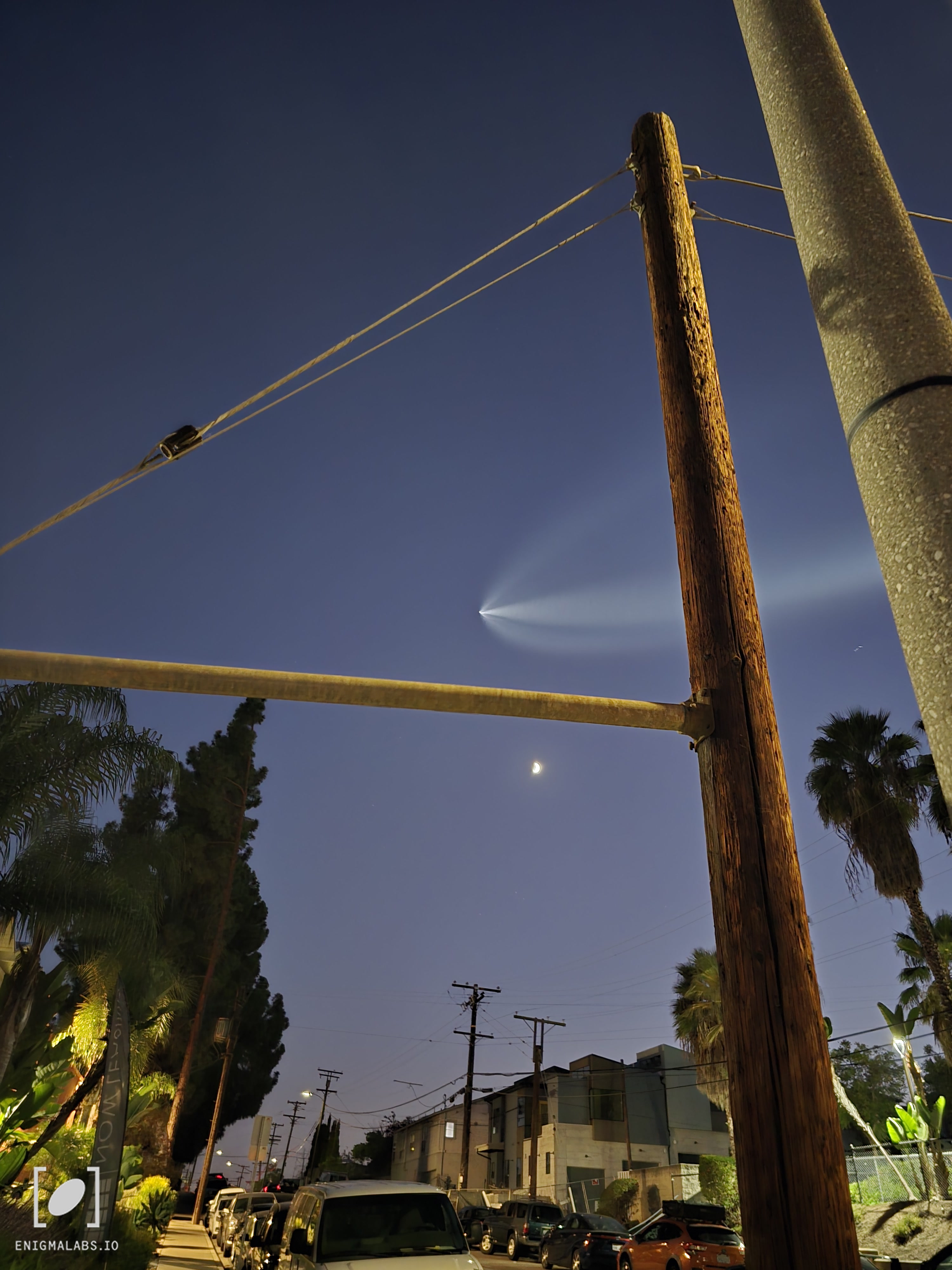
Witnesses describe a comet, a jet with a glowing tail, a teardrop of light at twilight. In most cases it’s a rocket’s second stage, seen from under the flight path.
View In AppA rocket launch can look extraordinary from hundreds of miles away, especially when the observer has no idea what they’re seeing. A bright point of light climbs into the twilight, unfurling into a glowing plume that spreads across the sky. It moves unlike a plane and lingers far longer than a meteor. For someone witnessing it unexpectedly, the display can be difficult to explain.
This is one of the most recognizable rocket-launch signatures in Enigma reports. As launch activity has accelerated over the past decade, these sightings have become more common. Exhaust plumes can be visible across vast distances. A launch that lasts only minutes at the pad can produce a spectacle that unfolds across the sky for observers, many of whom have no reason to suspect a rocket is responsible.

Enigma #330468
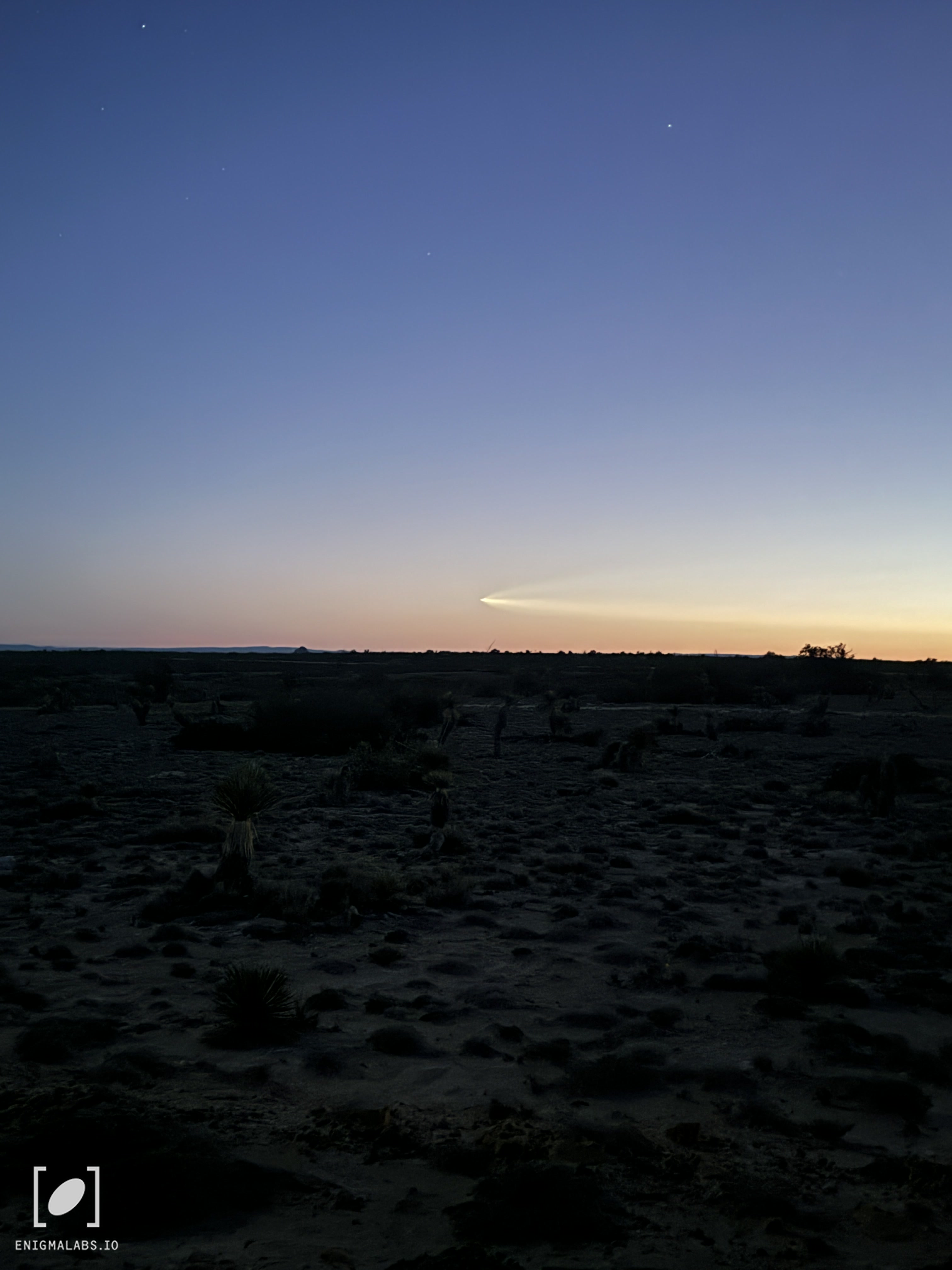
Enigma report #330468, shown above, captures a rocket near stage separation, roughly two and a half to three minutes after liftoff, at an altitude of about 43 miles. The bright white point is the second stage, which has just ignited. Behind it, the exhaust expands rapidly into a broad, translucent plume. At that altitude, the atmosphere is too thin to constrain the gases, allowing them to spread into a shape many times wider than the rocket itself. The trail extending behind it is the first stage's exhaust.
These sightings tend to occur at dusk or dawn, when the ground is in shadow but the rocket, dozens of miles above Earth, remains in direct sunlight. The exhaust catches the light against a dark sky, transforming an otherwise invisible trail into a luminous, expanding cloud. The effect is fleeting, dependent on the right combination of altitude, sunlight and viewing angle. It also helps explain why plume reports cluster around sunrise and sunset, particularly along the ground track of a launch or within the surrounding region.
Enigma’s Sighting Data
Booster sightings don’t announce themselves in a database. Witnesses used 18 different shape tags to describe the objects they saw. “Fireball” was the most common, with 23 reports, followed by light, unknown, sphere and cone. Others were tagged as disks, chevrons, teardrops or objects that appeared to change shape. Searching any single tag would have returned a mix of meteors, aircraft and unrelated lights while missing many of the reports we wanted.
Instead, we searched the descriptions for the visual signatures of a first-stage booster: a bright point trailing a widening plume and exhaust fanning outward as the rocket climbs.
As of October 15, 2026, there are 85 sightings with media. We consider the 85 a conservative count, since reports without media or descriptions outside our search criteria may have been missed.
The geographic distribution fits the physics of a first-stage burn. Because the booster operates for only a few minutes, most sightings cluster near the launch site and along the rocket’s early trajectory. California accounts for nearly 40% of the sightings and Florida for 19%, together representing 57% of all reports.

More surprising is how far visibility can extend in that brief window. Fifteen reports came from more than 600 miles away, including New York City, the New Jersey shore, eastern Pennsylvania, far West Texas and Oakville, Ontario.
A booster’s visible footprint isn’t a circle around the launch pad. It’s a corridor that follows the rocket. When exhaust catches sunlight while the ground below is in twilight, the resulting display can be visible well over a thousand miles away.
Matching Sightings to Real Rocket Launches
To validate the 85 sightings, we looked beyond our own data and checked each one against independent records of real rocket launches. We used the date, time and city recorded for each sighting in the Enigma database, converting the timestamp to the sighting’s local time zone. We then compared each sighting against public launch records for every major U.S. launch site, including Vandenberg, Cape Canaveral, Kennedy Space Center, Wallops and Starbase.
A sighting counts as a match only when a launch occurred within one day of the sighting. We then assessed the geographic relationship between the sighting and the launch:
- Strong match: The media clearly shows a rocket launch, and the sighting occurred in the same state as the launch site or along the launch’s flight path.
- Weak match: The media clearly shows a rocket launch, but the sighting’s location falls outside that launch’s visible range.
Of the 85 sightings, 81 matched a real launch within one day. Of those, 76 were strong matches and five were weak matches. Four sightings had no corresponding launch within the one-day window.
Sighting Matches
Strong Match
Weak Match
No Launch within One Day
Below, explore the sighting media for a closer look at the reports and the rocket launches behind them.
Gallery


Sightings
-
2021 SEP 24
-
2023 DEC 11
-
2023 DEC 28
-
2024 MAR 04
-
2024 MAR 18
-
2024 APR 01
-
2024 APR 04
-
2024 APR 06
-
2024 APR 27
-
2024 MAY 17
-
2024 JUN 19
12:00:00 AM EDT
Compton, California, United States
Bright, transparent UAP with smoke trail and smaller lights trails south.
-
2024 JUN 23
11:50:00 PM EDT
Menifee, California, United States
Tiny objects orbiting SpaceX rocket's exhaust plume.
11:51:00 PM EDT
San Clemente, California, United States
Fast, green UAP follows SpaceX rocket, outpaces secondary boosters.
11:53:00 PM EDT
Amargosa Valley, Nevada, United States
Orb descends behind mountain after rocket launch, captured on video. -
2024 JUN 24
12:49:09 AM EDT
Santee, California, United States
Rocket-like object trails dots across sky, 80-100 lights form 3-6ft long streak. -
2024 JUL 03
5:02:00 AM EDT
Pennsauken, New Jersey, United States
Translucent orb-shaped object passes plane, lands near Philadelphia Airport. -
2024 JUL 06
-
2024 AUG 24
-
2024 SEP 10
-
2024 SEP 12
-
2024 SEP 28
-
2024 OCT 18
-
2024 NOV 04
-
2025 JAN 24
-
2025 FEB 04
6:20:19 PM EST
Wilmington, North Carolina, United States
Large silver cylindrical object moving slowly
7:17:00 PM EST
Wilmington, North Carolina, United States
Whirling spiraling cloud moving west then zipping back -
2025 FEB 10
10:20:00 PM EST
Littlefield, Arizona, United States
Multiple white orb-like objects surrounding a straight-moving white cylindrical shape -
2025 FEB 22
-
2025 MAR 12
11:18:00 PM EDT
Deerfield Beach, Florida, United States
Bright red-blue streak shooting through the sky -
2025 APR 21
9:01:06 PM EDT
Cape Coral, Florida, United States
Small round shape changes direction then disappears -
2025 APR 22
-
2025 JUN 16
-
2025 JUL 09
-
2025 JUL 19
-
2025 JUL 29
-
2025 SEP 10
-
2025 SEP 18
5:33:00 AM EDT
Jacksonville, Florida, United States
Fast white streak with glowing aura moving slowly -
2025 SEP 21
-
2025 SEP 28
10:08:27 PM EDT
La Mesa, California, United States
Space X launch followed by multiple breaking apart objects
10:23:15 PM EDT
San Diego, California, United States
Bright light leaving glowing trail dropping small round objects
-
2025 OCT 07
-
2025 OCT 13
7:30:00 PM EDT
Yankeetown, Florida, United States
Bright glowing orb moving quickly with smoke trail
-
2025 OCT 16
-
2025 NOV 10
-
2025 DEC 02
12:31:22 AM EST
Compton, California, United States
Two red glowing objects emitting red beams moving south -
2026 JAN 02
-
2026 FEB 14
-
2026 MAR 01
5:13:58 AM EST
Santa Monica, California, United States
Reddish yellow tail moving swiftly another light descending -
2026 APR 06
10:54:00 PM EDT
Los Angeles, California, United States
Bright white rocket-like object rising rapidly -
2026 APR 14
-
2026 JUL 09
-
2026 JUL 31
11:15:40 PM EDT
Moreno Valley, California, United States
White spec with expanding contrail moving in the sky -
2026 OCT 12