
Enigma Collection


147 witnesses describe losing time during or right after a sighting. Some read it off a clock, some arrive hours late, and some were found by family who had been searching for them.
View In AppIn most UAP reports the witness describes what they saw. In a small set of sightings, the witness also describes a stretch of time they cannot account for. A witness watches a light over the road, a disc over the trees or an orb outside a bedroom window, and then the clock says hours have passed. Some arrive somewhere with no memory of the trip. Others are found by family members who have been calling their name.
Researchers call this "missing time." The phrase came into use in the early 1980s to describe a gap between the last thing a witness remembers and the next.
Across the Enigma database, we identified 147 sightings in which witnesses described losing time during or right after an encounter. In 80, the witness says outright that time went missing or describes a clock, an arrival time or a distance that does not add up. In the other 67, the witness remembers the event up to a point, then a later point, and cannot account for what happened in between. We counted only what witnesses wrote in their own words, we did not include memories recovered through hypnosis!
Together the accounts show how witnesses notice that time is gone, what they remember on either side of the gap, and how they live with it afterward.
Well Known Historical Cases
Reports of missing time go back more than half a century, and many of the best-known cases are in similar settings as Enigma's own reports: a night drive, a rural road, a light near the vehicle.
In one of the most famous well-known historical cases, in September 1961, Betty and Barney Hill were driving home through New Hampshire when a light appeared to follow their car. Barney stopped to look through binoculars and said he saw figures at the craft's windows. By their own account, they reached home about two hours later than expected, with little memory of roughly 35 miles of road. A NICAP investigator interviewed them within weeks, and their story became the 1966 book The Interrupted Journey, subtitled "Two Lost Hours Aboard a UFO". Their account of being taken aboard came later, under hypnosis.
In 1975, a forestry crew near Heber, Arizona, said a beam from a glowing object knocked their co-worker Travis Walton to the ground. When they returned, he was gone. He reappeared five days later, saying he remembered only about an hour or an hour and a half. Skeptics including Phillip J. Klass argued it was a hoax.
The next summer, four art students night-fishing on Maine's Eagle Lake said a beam surrounded their canoe. They believed they had been on the water less than 20 minutes, but the fire they had built as a beacon had burned down to coals. One of the four has since said the abduction they later described under hypnosis did not happen.
In 1980, police constable Alan Godfrey saw an object over the road near Todmorden, England, saw a flash and found himself still driving 100 yards farther on, an estimated 15 minutes later. In 1993, Kelly Cahill and her husband, driving through the foothills east of Melbourne, saw a large craft and a blinding light, then found themselves driving on with no memory of the gap.
Artist and researcher Budd Hopkins popularized the term "missing time" with his 1981 book of that name, which treated a gap in memory as a possible sign of abduction. Hypnotic regression became the standard tool for recovering what happened during the gap, and it remains contested: many of the best-known abduction narratives, including the Hills', emerged only under hypnosis. Researchers have also proposed ordinary explanations, including memory distortion on long highway drives, sleep paralysis, and false memories produced under hypnosis. The Enigma collection includes only what witnesses remembered on their own, without additional methods like hypnosis.
What Enigma's Data Shows
Missing time is rare in the database as a whole: 147 out of nearly 42,000 approved user-submitted sightings. Within the collection the same details recur. More than a third of witnesses say a companion shared the same gap. Nearly a third found themselves somewhere other than where they last remembered being. Most of the events took place at night.

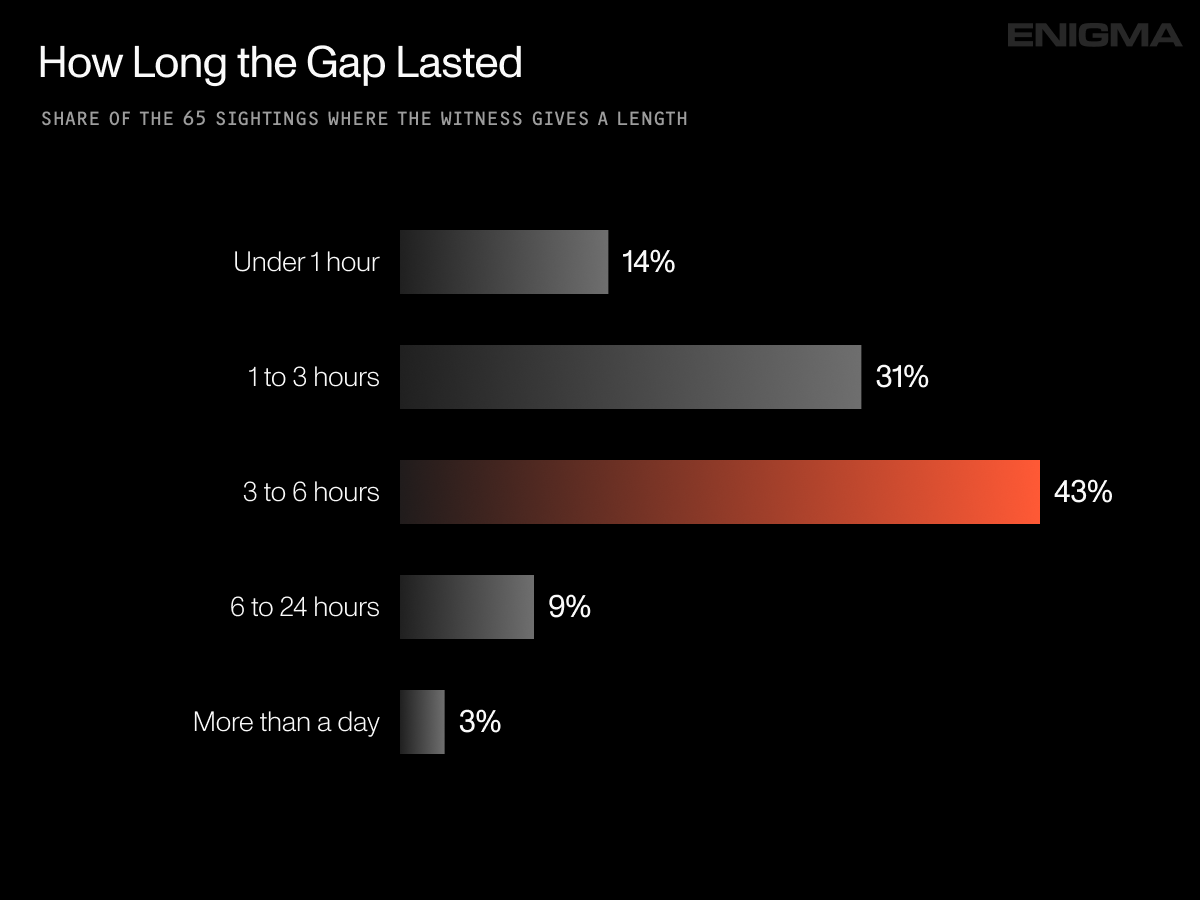
Fewer than half of witnesses say how long they lost. Of the 65 who give a length, most describe a gap of one to six hours. The median is three hours. A handful describe losing a full night, and two describe losing days.
Triangles are the single most common shape in this collection – but orbs, spheres and lights together account for about a third of reports.

The events in our user’s reports span nearly seven decades, from 1959 to 2026. Many witnesses reported their experience years after it happened. More than 40% took place before 2000, and more than a quarter of witnesses were children at the time.
The Stories
The clock said otherwise
In many accounts, the first sign that something happened is a clock. The witness believes a few minutes have passed but the clock, a watch or a phone says otherwise.
- At the Mammoth Lakes hot springs in California, four friends were soaking at about 8:45 p.m. when a bright, silent light flew in from the horizon and stopped directly above them. The witness's next memory was the light going straight up. The friends left believing it was around 9 p.m. Twenty miles into the drive home, the witness looked at the truck's clock. "I said it’s 2:20am !!! He said your clock is wrong and looked at his wrist watch and said it is." One companion, a former Air Force helicopter crew chief, also saw the light leave. (#287339 )
- In New Jersey in 1975, a teenager with an 11 p.m. curfew walked up to a brightly lit craft hovering beside a roadside barrier wall while a friend locked himself in the car. The event "felt like it took about 4-5 minutes." The witness dropped the friend off and drove home. "But as I walked in the house and looked up at the clock over the sink it read 530am! At first I thought the clock had stopped, I walked closer so I could see the second hand and it was running." The friend never wanted to discuss it. (#326518 )
- In 1998, a 12-year-old who couldn't sleep opened the curtains and watched a round light release smaller lights "of so many colours". The witness started watching at around 1:30 a.m. and felt unable to look away. "I then looked at the clock and it was about 6am and I ran into my parents room to tell them what happened." (#289733 )
- In Massachusetts, an 11-year-old woke before dawn, "as if I had been compelled to go take a peak out of my bedroom window", and saw a rotating, ring-shaped craft with six white lights. About 30 seconds later, "everything went black". She describes it as spacing out for a couple of seconds. "I looked over at my little plastic alarm clock and it was 5:45 and over two hours had passed". She told no one. (#331608 )
The drive that ran long
About a quarter of the accounts take place in a vehicle. Drivers know how long a familiar route takes, which makes the discrepancy easy to measure: in hours, in arrival times, or in miles. Night driving has a well-known ordinary explanation: on long or familiar routes, drivers can cover miles with little memory of the road, and some witnesses in the collection raise fatigue themselves.
- Near Clarksville, Indiana, two friends set out at about 3:30 a.m. on what the witness calls "about a 15 minute drive". A large saucer-shaped craft appeared ahead of them, and they turned onto a side road where a friend lived and roused his father. "Honestly I dont remember it leaving." They talked with him for no more than 20 minutes and drove on, and "when we got there it was 6:30 am. I'm not saying I was abducted cause I dont recall that at all, but we definitely have missing time." (#319835 )
- In Newnan, Georgia, two friends watching a purple orb from a parked truck saw a triangular craft appear 20 to 25 feet above them. The witness drove off while the friend reported it was following them. "Go somewhere where there's people go to Walmart. And that's what we did. Now, this was between 1145 and 12:00 at night. Well, things are very hazy. The next thing that we recall is pulling up in the parking lot at Walmart at about 02:00 a.m." (#281955 )
- In England, a witness drove out in the middle of the night to get a closer look at lights over a field near home. "Looking at the car’s clock, I saw that it was 3:15 am." On the way, the witness passed a pale oval craft with two tall figures standing at its door, panicked and took a wrong turn onto the motorway. "When I got back home at 5 am, and this in itself was unusual, as this journey usually takes twenty minutes at most. My husband asked me where I had been." (#288133 )
Someone noticed they were gone
Some witnesses learn about the gap from other people: a parent searching the yard, a mother asking where they have been, a cleaner at a club that had already closed.
- In Georgia in 1995, a four-year-old playing near the wood line saw a large, silent, triangular craft come over the trees. "The trees still were not moving, just my hair. I remember I tried to run but I could not move. The next thing I know my mom, my sister, and my brother were in the yard yelling my name. I stood up off the ground and said I was right here." Their mother said the child had been missing for almost an hour. (#279692 )
- Two 16-year-olds took an 8 p.m. train to a club that opened on Tuesday nights. Walking from the station, the witness felt a sudden pressure, "Like my head was underwater", saw a very bright light and fell. The friend was on the ground too. They got up laughing and walked on, but the car park was nearly empty and the doors were locked. "I go, What time is it now? She said, Five o'clock in the morning. We did not believe her." By the time they reached the station, dawn was breaking. (#292434 )
- In England in 1981, a child and an older brother watched a green orb with a flashing red light from the back window while their mother worked a late shift. "The next thing we both knew it was nearly midnight and more then 3 hours had passed and we were both still at the window looking into the back garden and my mum was putting her key in the door". Twenty years later, the brother, whom the witness describes as "the most skeptical person you could meet", remembered everything except the missing time. (#320938 )
The next thing I knew
In the memory-gap accounts, the witness does not read the time off a clock. They describe a jump: from the yard to the bedroom, from a bridge to the woods, from night to morning.
- In Wisconsin, a driver on the way to a drive-in theater in daylight saw a silver disc flashing above the railroad tracks. The driver turned the car around and followed it to the edge of a stand of woods, where a bigger light shone inside. "I followed it to the edge of the woods, and I don't remember even getting to the drive-in. I'm not saying I was abducted, I'm just saying I don't remember the rest of the night." (#303228 )
- At Lake Sylvia in Washington, an astrophotographer followed a fast-moving light with a strobe while texting their wife at home. The witness describes what came next: "that was the last thing i remember until i was all of a sudden walking out of the woods stumbling like i was drunk or just waking up from surgery!" The equipment was on the bridge exactly as they had left it. The test photo was gone. (#278621 )
- In Burnley, England, a teenager and their sister, standing in their back yard, watched a huge silent disc rotate slowly over the terraced rooftops while a neighbor shouted about it. "Neither my sister or I can remember what happened next, how it disappeared or where it went. My next memory is being in my bedroom, at my window looking into the sky, closing my curtains." (#295975 )
- In Maine, hours after a family drive during which everyone in the car saw a large disc cross the road, a witness looked out a bedroom window at around 1 or 2 a.m. and saw three bright lights by the tree line. The witness heard "a high pitched ringing in my ear" and "simply squinted with a pain for 2 seconds". When they opened their eyes, "it was broad daylight". "No memory of going to sleep. I just kind of blink then poof it’s daytime. Still standing in the same spot by the window. I find out eventually it’s around 9:30am." (#324292 )
What the Stories Have in Common
More than a third of these witnesses were not alone. A companion lost the same stretch of time: two friends who pulled into a Walmart parking lot at 2 a.m., a brother and sister still standing at the back window when their mother came home, two teenagers who reached their club at dawn. The best-known historical cases share this detail. Betty and Barney Hill, the four Allagash canoeists, and Kelly Cahill and her husband each described a gap they lost together. One tired driver can lose track of an hour, but that is harder to say of two people who describe the same missing hours. Several companions later refused to talk about what happened.
For many witnesses, their report to Enigma is the first time they have described the experience at all. Seven say they had never told anyone before. Another 18 had told only family or a few close friends, or had not spoken about it for years, in some cases for more than two decades. “I never told anyone about this until now because I was afraid people would think I was being dramatic and nuts,” one witness wrote. Another, who was 11 when she saw a craft outside her bedroom window, “told absolutely nobody out of fear of being laughed at or embarrassed”.
Whether these experiences reflect something about the phenomenon itself or how memory behaves under stress remains an open question. These accounts, from 1959 to the present, record what witnesses remember on either side of a gap they cannot explain..
Explore the sightings in this collection below. If you’ve had an experience like these, submit your sighting , even if you have never told anyone. The more people share their accounts, the easier it becomes to identify patterns, compare experiences, and ask better questions.
Gallery
Enigma #326518
Score [56]
1975 DEC 28 • 10:15:00 PM EST
 View Sighting →
“Half of me wants to know what happened in that missing time but the other half thinks maybe its best not to know.”
Enigma #288899
Score [55]
1964 AUG 08 • 12:20:00 PM EDT
View Sighting →
“I’m 69 years old, and I just feel like something should be documented somewhere before I leave this earth.”
Enigma #289733
Score [64]
1998 MAR 31 • 7:30:00 PM EST
 View Sighting →
“It felt like 5 minutes but when I snapped out of the fixation on the thing and moved away from the window hours had passed”
Enigma #331608
Score [50]
2017 JUN 15 • 3:30:00 AM EDT
View Sighting →
“The ground below was being illuminated by this giant donut shaped craft...it was 5:45 and over two hours had passed”
 @lilac-uap-vds
Enigma #274767
Score [46]
2023 FEB 01 • 11:30:00 PM EST
View Sighting →
“I felt an overwhelming calm like a feeling I’ve never felt before like everything is going to be fine.”
Enigma #336464
Score [41]
2026 JAN 18 • 2:05:00 PM EST
View Sighting →
“I had 60 miles to my exit and somehow lost a few hours and ended up 100 miles past my exit. I remember driving but it felt like 30 minutes.”
 @tracing-edges_361